Feeling Anxious for No Reason? You're Not Alone
When anxiety shows up with no clear cause, it's easy to assume something is wrong with you. It isn't. Here's why the feeling arrives uninvited, a one-minute practice to meet it, and a gentler way to let it pass.
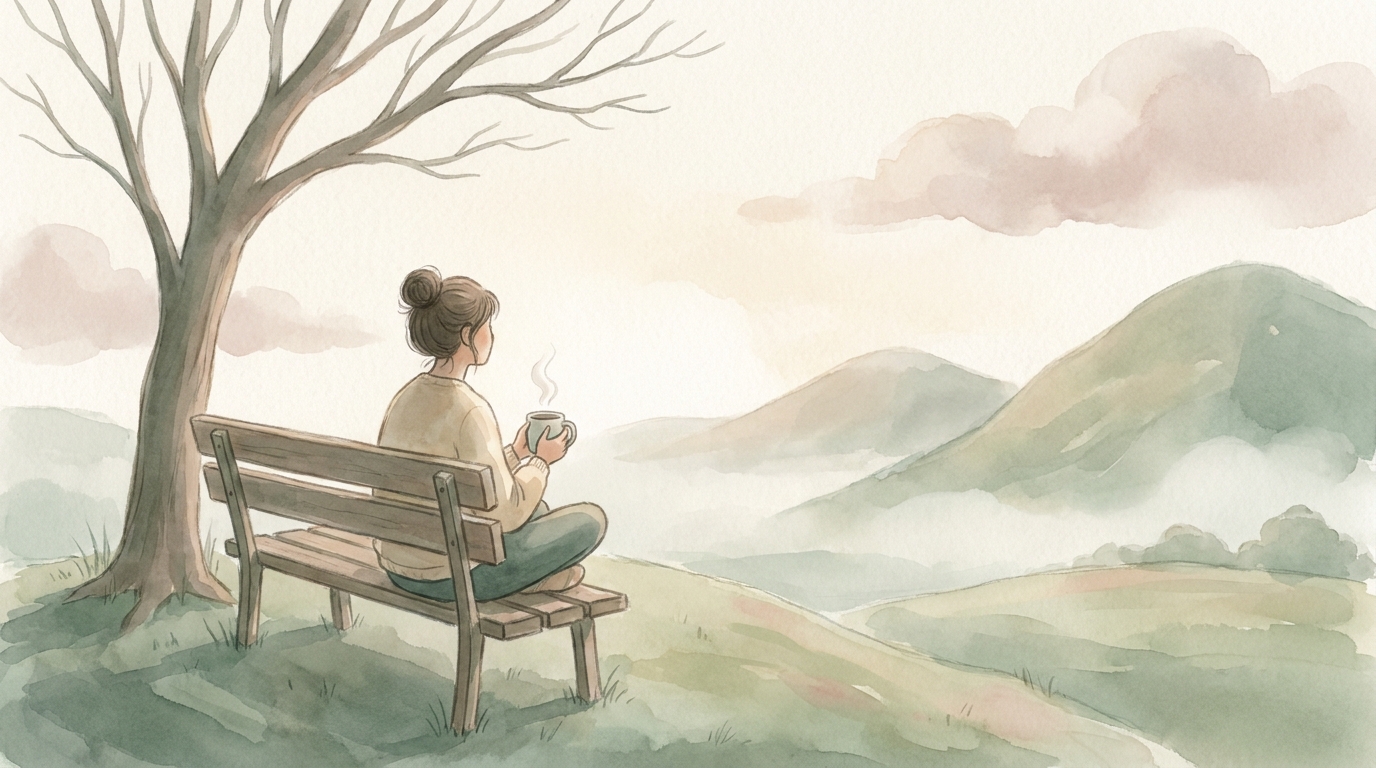
You wake up and nothing is wrong. No deadline on fire, no fight with anyone, no bad news waiting on your phone. And yet your chest feels tight, your thoughts are already three steps ahead of you, and a low hum of dread sits underneath everything you do. If this sounds familiar, you are not broken, and you are not alone. Feeling anxious for no reason is one of the most common human experiences — and one of the most confusing, precisely because it shows up without a story to explain it.
Most of what we're taught about anxiety assumes there's a cause to find. Find the cause, fix the cause, feel better. But some days the anxious feeling arrives on its own schedule, unconnected to anything you can point to. That mismatch — feeling threatened while nothing threatening is happening — is often what makes the experience so unsettling. You start to feel anxious about being anxious. This isn't about diagnosing why. It's about what to do with the feeling while it's here.
Why Anxiety Doesn't Need a Reason
Your mind carries a built-in alarm system, and that system was built for speed, not accuracy. It doesn't wait for you to confirm there's a real problem before it starts ringing. A short night of sleep, a skipped meal, too many hours of scrolling, an old argument you replayed in your head three days ago — any one of these can leave the alarm a little more sensitive than usual, ready to fire at nothing in particular. It fires first and asks questions later, if it asks at all.
The feeling is real. The threat, most of the time, is not. Understanding this small distinction doesn't make the anxious feeling disappear, but it removes one layer of suffering on top of it: the belief that something must be deeply wrong with you for feeling this way when "nothing happened." Something did happen — it's just happening inside you, in your body and your nervous system, not out in the world. That's a very different, and much less frightening, kind of problem.
A One-Minute Practice: Name What's Here
You don't need to solve anxiety to loosen its grip on you right now. Try this the next time it shows up, wherever you are.
Sit or stand still for a moment. Silently name three things you can physically sense — the weight of your feet on the floor, the temperature of the air on your skin, the feel of your own breath moving in and out. Then name the feeling itself, plainly, without arguing with it: "This is anxiety. It's here right now." Take one slow breath in through your nose, and let it out even slower than it came in.
That's the whole practice, start to finish, in under a minute. It won't erase the feeling — that isn't the goal, and chasing that goal usually backfires. The real goal is to stand next to the feeling instead of being swallowed by it. Naming what's happening, in the body and in the mind, gives you a small amount of distance from it. And distance is often all that's needed to keep one anxious moment from snowballing into an anxious hour, or an anxious morning into an anxious day.
The Feeling Is Weather, Not Climate
In many mindfulness traditions, a difficult feeling is described as weather passing through a sky that never actually changes. Storms move through the sky. Clouds gather and clear. But the sky itself doesn't become the storm — it simply holds it, lets it move, and stays sky. You are the sky. Anxiety is weather: real, sometimes intense, occasionally relentless, but not permanent, and not the whole of who you are.
This isn't a suggestion to pretend you don't feel anxious, or to force yourself into a calm you don't feel. It's a much gentler shift: remembering that a feeling passing through you is not the same as a feeling defining you. When you can watch an anxious thought arrive — "something's wrong," "what if," "I can't shake this" — without immediately agreeing with it or fighting it, you give it room to move through instead of settling in for the day. In quiet, ordinary experience, feelings that are watched tend to loosen their grip. Feelings that are wrestled with tend to dig in harder, because resistance itself feels like more evidence that something is wrong.
If It Comes Back Tomorrow, That's Normal
Anxious mornings — or anxious moments that appear out of nowhere in the middle of an ordinary afternoon — often come back more than once. That's not a sign that anything you're doing is failing. It's a sign that you're a person with a nervous system that is doing its job a little too enthusiastically. Nervous systems don't get retrained in a single sitting.
Each time you notice the feeling, name it, and breathe with it instead of running from it or arguing with it, you're building something like a habit of steadiness. It rarely feels dramatic in the moment. It usually feels like a very small, quiet pocket of okay-ness in the middle of a not-okay feeling — barely noticeable, easy to dismiss as nothing. But those small pockets add up over weeks, the way any quiet habit does. You don't need to win against anxiety in one round, and there's no scoreboard keeping track. You just need to keep meeting it, breath by breath, the same patient way a good friend keeps showing up — not to fix you, just to sit with you until the weather passes.
Want a gentle place to start? One Quiet Breath: How to Calm an Overthinking Mind is a free little book, yours to keep. Twelve short chapters, twelve tiny practices you can do in a single breath. Download it free here.