How to Put Tomorrow's Worries Down Before Bed
A calm, practical guide to quieting nighttime worry about tomorrow. Learn why the mind reaches for tomorrow's problems at bedtime, a one-minute writing practice to set worries down, and a gentler question to ask than 'how do I stop worrying' so you can actually rest.
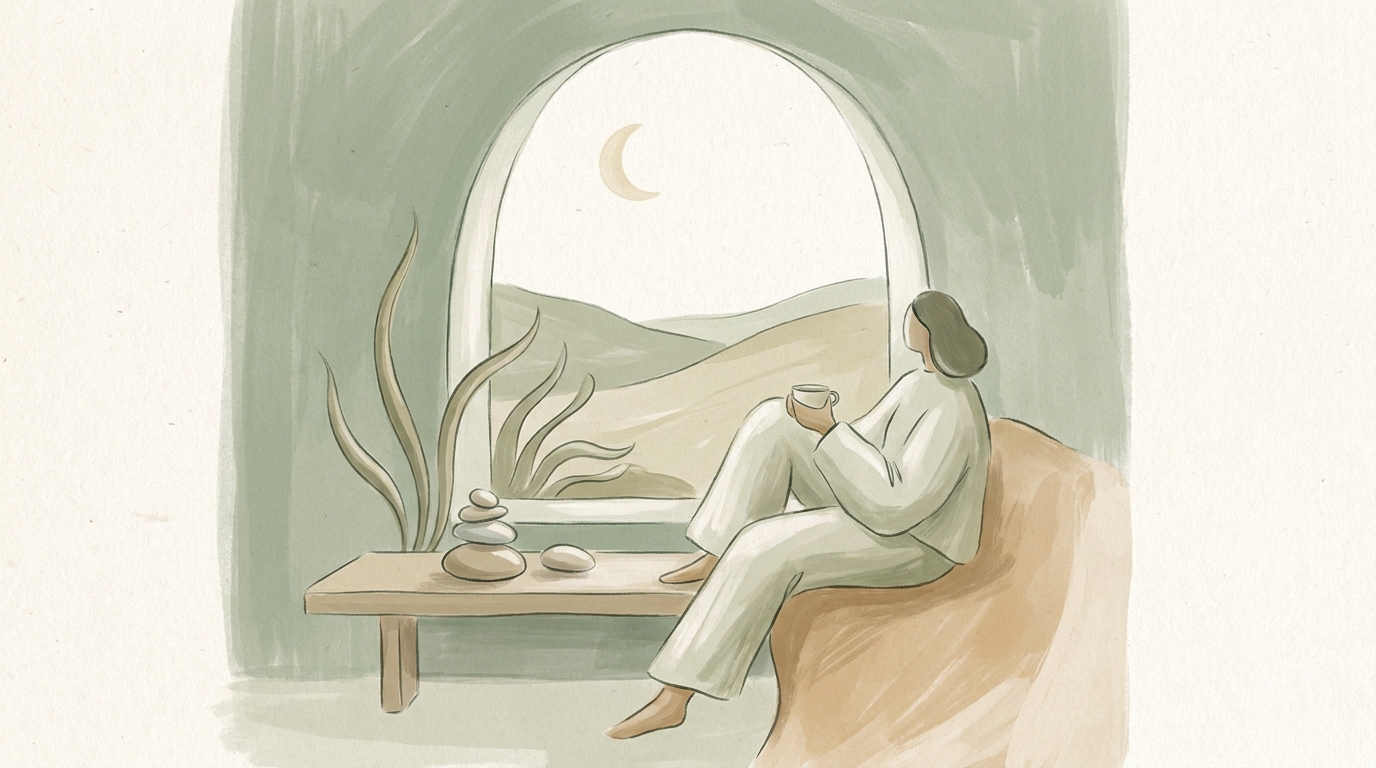
It's almost always the same moment. You turn off the light, pull the blanket up, and your mind decides this is exactly when it wants to have a meeting. Tomorrow's meeting, tomorrow's phone call, the thing you said wrong three years ago, the bill that's due, the argument you haven't had yet. If you've ever wondered how to stop worrying about tomorrow at night, you already know the strange truth about it: worry doesn't show up when you have time to deal with it. It shows up when you're finally still enough to hear it.
That's not a flaw in you. It's just what an unoccupied mind does. During the day you're moving, talking, solving small problems one after another, and the mind has somewhere to put its energy. At night, the noise of the day stops, and everything you didn't finish thinking about comes forward at once, uninvited, like guests who've been waiting outside the whole time.
Why Your Mind Chooses Bedtime to Worry
Worry likes to disguise itself as preparation. It tells you that if you just think about tomorrow hard enough tonight, you'll be ready for it. But notice what actually happens: you go over the same few sentences of an imagined conversation, or the same worst-case version of tomorrow, again and again, and you never arrive anywhere new. That's the tell. Real planning moves forward and reaches a decision. Worry just loops.
There's an old, simple idea worth borrowing here, stripped of any temple or ceremony: a mind left alone will grab onto whatever is nearest, the way a hand in the dark reaches for anything within reach. At night, what's nearest isn't the present moment — the present moment is just you, lying still, in a quiet room. So the mind reaches instead for tomorrow, or for yesterday, because those at least feel like something to hold onto. The work isn't to force the mind to stop reaching. It's to give it something steadier to hold instead.
A One-Minute Practice: Empty the Mind onto Paper
Here's something you can do tonight, and it takes about a minute. Keep a small notebook, or even a scrap of paper, by your bed. When a worry about tomorrow surfaces, don't argue with it and don't try to solve it in your head. Just write it down in a few words — "call the clinic," "email running late," "haven't decided about the trip" — and nothing else. No plan, no solution. Just the name of the thing.
This works because most nighttime worry isn't actually asking you to solve anything. It's asking to be remembered. The mind repeats a thought because part of it is afraid that if it lets go, the thought will be lost and something will go wrong because of it. Once you write it down, you've told your mind, in a language it understands, "I've got this — you can put it down now." You're not solving tomorrow's problem at eleven at night. You're proving to your own mind that the problem has a home outside your head, and it will still be there in the morning, when you actually have the ability to do something about it.
A Gentler Question Than "How Do I Stop?"
Trying to stop a thought head-on rarely works — it's a bit like being told not to think of something, which only makes it louder. A softer approach is to change the question you're asking. Instead of "how do I stop worrying about tomorrow," try asking, "does this thought need anything from me right now?" Almost always, at eleven at night, the honest answer is no. There's no phone call you can make, no email you can send, no decision that's actually available to you in this exact minute. The thought carries urgency, but the moment itself has none to give it.
You can say this to yourself plainly, almost like talking to a worried friend: "I hear you. There's nothing to do about this right now. We'll look at it in the morning." This isn't denial — you're not pretending the thing doesn't matter. You're just being accurate about when it can actually be handled. Tomorrow's problems belong to tomorrow's version of you, who will have more information, more energy, and more room to act than the tired version of you lying in the dark.
Let the Body Go First
One more thing worth knowing: the mind often follows the body, not the other way around. If you lie there trying to think your way into calm, you're asking the very part of you that's making the noise to also fix the noise. Instead, let your attention drop out of your head for a moment — notice the weight of the blanket, the temperature of the room, the actual physical feeling of your breath moving in and out. You're not forcing relaxation. You're just giving your attention somewhere real to rest besides tomorrow. A mind that has somewhere solid to stand doesn't need to keep reaching into the future for ground.
None of this makes tomorrow's problems disappear. The bill is still due, the conversation still needs to happen. But there's a real difference between carrying a worry and rehearsing it three hundred times before sunrise. One prepares you. The other just steals your sleep and gives nothing back. Tonight, when the meeting starts in your head, you can simply say: not now, not needed, write it down, let the body settle — and let tomorrow start when it actually arrives.
Want a gentle place to start? One Quiet Breath: How to Calm an Overthinking Mind is a free little book, yours to keep. Twelve short chapters, twelve tiny practices you can do in a single breath. Download it free here.