It's Not Just You: The Mind That Won't Turn Off at Bedtime
Why your mind gets loudest exactly when you want it quiet, and a one-minute practice to work with a racing mind at night instead of fighting it into silence.
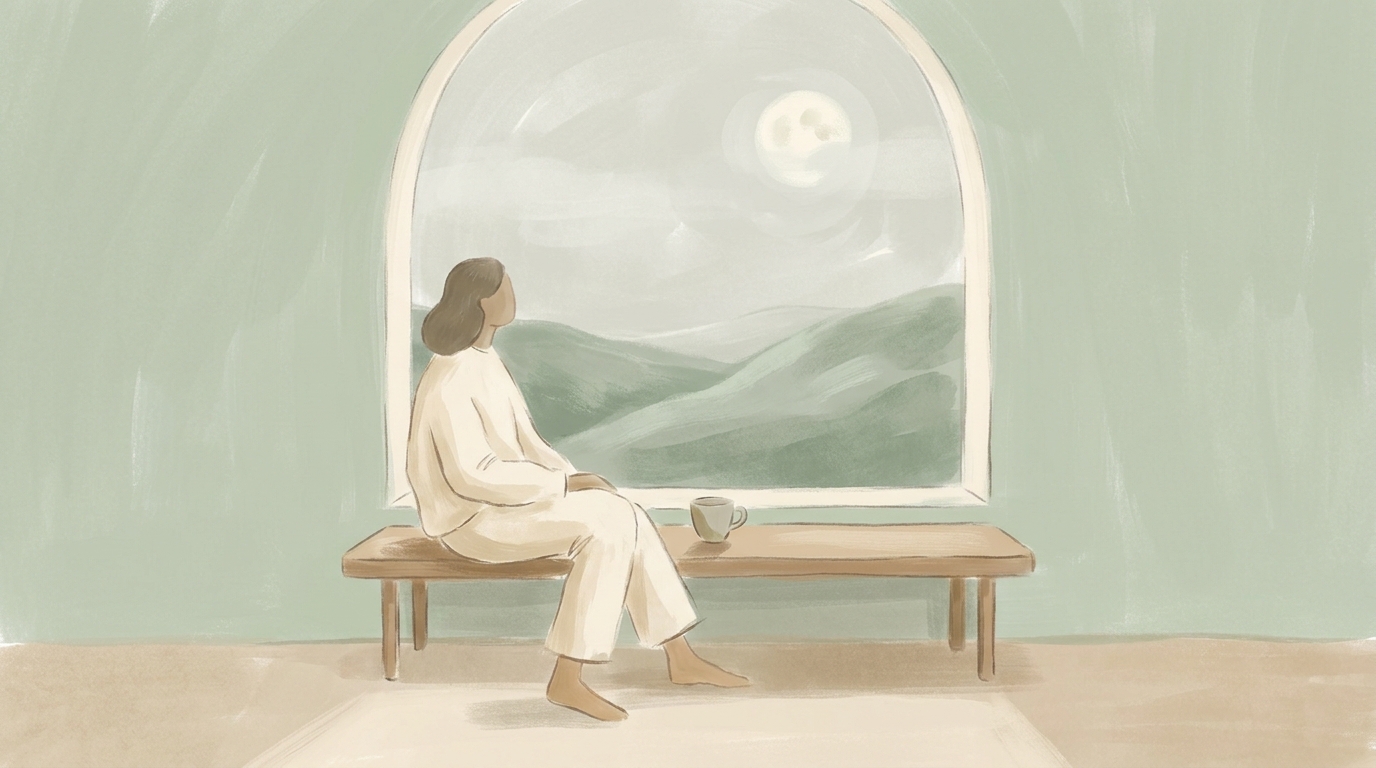
It's 11:47 pm. Your body is tired. Your eyes are tired. But your mind has just opened a meeting, and everyone showed up: the email you forgot to send, the thing you said three years ago that still makes you wince, tomorrow's to-do list rehearsing itself on a loop. You didn't invite any of this. It just started, the moment the lights went off and the day stopped giving you anything else to look at.
If this happens to you, you are not broken, and you are not alone. A mind that won't turn off at night isn't a personal failing — it's what an unoccupied mind tends to do. All day, your attention is busy handling things: talking, driving, deciding, reacting. At night, the outside world goes quiet, but the mind doesn't know how to go quiet with it. So it turns inward and starts sorting through everything it didn't have time to look at during the day. The volume feels louder at 11 pm not because the thoughts are worse, but because nothing else is competing for your attention anymore.
Why the Mind Picks Bedtime to Get Loud
Think of your mind like a room that's been cluttered all day. During work hours, you keep stepping around the mess because you have somewhere to be. At night, you finally stand still in the middle of it — and now you can see everything at once. That flood isn't the mind malfunctioning. It's the mind finally getting a moment to process what the day didn't let it finish.
The trouble is, lying in bed is a strange place to do that processing. Your body is signaling "rest," but your mind has started a task and, like anything left half-done, it wants to keep going until it feels resolved. Most nighttime thoughts never actually resolve, though — they just loop. The same worry replays with slightly different wording, convincing you each time that this pass will be the one that fixes it. It rarely is. That's not a sign you need to think harder. It's a sign the thought has already said what it came to say, and the rest is just repetition dressed up as productivity.
You're Not Trying to Stop the Thoughts — You're Trying to Stop Believing Them
Here's something worth sitting with: you don't actually need your mind to go silent in order to sleep. Plenty of people fall asleep with thoughts still drifting through. What keeps you awake isn't the presence of thoughts — it's the grip you take on them, the way you climb inside each one and live there for a while, arguing, defending, replaying.
An old, simple piece of wisdom says the mind is not the enemy — it's more like weather passing through a sky. Clouds show up, some of them dark and heavy-looking, but the sky itself is never harmed by them, and it never has to chase a cloud away to stay whole. Your awareness can hold a worried thought the same way — noticing it's there without needing to fix it, argue with it, or follow it all the way to its worst conclusion. The thought is real, in the sense that it's happening. It's not necessarily true, in the sense that it deserves the authority you're handing it at midnight.
This is a shift you can only really learn by trying it, not by understanding it intellectually. So here's a small, concrete way to practice it tonight.
A One-Minute Practice: Naming the Room
When you notice your mind spinning at bedtime, don't try to stop the thoughts. Instead, spend one minute simply naming what kind of thought is present, the way you'd name weather. Silently label each one as it passes: "planning"... "replaying"... "worrying"... "planning" again. You're not solving anything or judging yourself for having the thought. You're just noting its category, like a weather report, and letting the next one come.
Do this for about a minute — roughly ten to fifteen labels. Most people notice something small but real: the thoughts don't stop, but the grip loosens slightly, because naming a thing puts a hair's width of space between you and it. You go from being inside the worry to standing next to it. That small distance is often enough for the body to remember it's allowed to rest, even while the mind keeps murmuring in the background.
What to Do When the Practice Doesn't "Work"
Some nights, naming your thoughts won't make you sleepy. It might not stop the loop at all. That's fine — this isn't a switch, it's a habit of relating to your mind differently, and habits take repeated, unglamorous practice before they show up when you need them most. The goal was never to force stillness. It was to remind yourself, even briefly, that you are the one aware of the thoughts, not the thoughts themselves. That awareness was never actually disturbed, even on the loudest nights.
If sleep still doesn't come, it's kinder to get up for a few minutes than to lie there fighting your own bed. Read something dull, sit in dim light, come back when you're drowsy. There's no failure in a hard night. There's just a mind that had a lot to carry today, doing what unoccupied minds do, waiting for you to notice it gently instead of at war with it.
Want a gentle place to start? One Quiet Breath: How to Calm an Overthinking Mind is a free little book, yours to keep. Twelve short chapters, twelve tiny practices you can do in a single breath. Download it free here.