The Monk Does Not Say Thank You
In Thailand, the monk who receives your food does not thank you. What that silence teaches burned-out professionals about the strange difficulty of receiving.
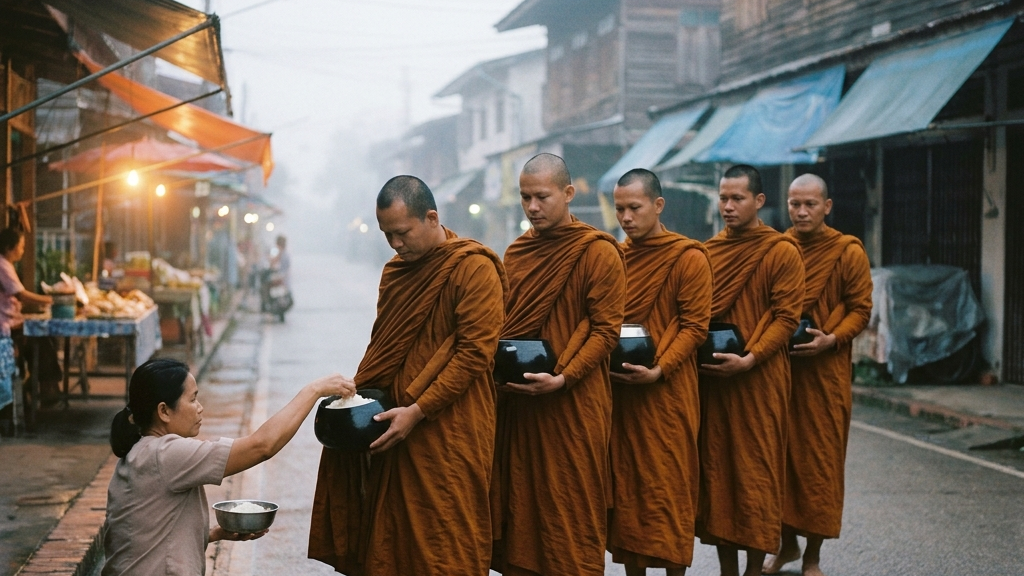
If you stand on a small street in Thailand at six in the morning, you will see something that has been happening every day for about two and a half thousand years, and that almost nobody there considers remarkable.
A line of monks walks barefoot down the road. Ochre robes, shaved heads, a black iron bowl held against the body with both arms. They do not knock on doors. They do not ask. They do not make eye contact with the people waiting for them. They simply walk, slowly, in single file, and stop when someone steps forward.
The person waiting is usually a woman, often older, sometimes still in the clothes she sleeps in. She has taken her shoes off, because you do not stand above a monk in your shoes. She kneels, or at least lowers herself, and puts rice into the bowl. Maybe a plastic bag of curry, knotted at the top. Maybe a carton of soy milk with a straw taped to the side, because this is a modern country and the dhamma has never been fussy about packaging.
The monk closes the lid. He does not thank her.
He gives a blessing, a few lines of Pali chanted in a low voice, and then he walks on. She pours a little water on the ground, sends the merit to somebody who has died, and goes back inside to get her kids ready for school. The dogs, who have watched this entire transaction with professional interest, go back to sleep.
The first time a Western friend of mine saw this, he was quietly offended on the woman's behalf. She got up early. She cooked. She knelt in the street. And he just took it and left?
Yes. That is exactly what happened. And once you understand why, it is difficult to look at your own life the same way again.
The direction of the favor
In the West, the giver is the hero of the transaction. The giver is generous, the receiver is in deficit, and the receiver settles the account by saying thank you. Thanks is a small payment that closes the loop and returns both parties to zero. This is so deeply built into how we speak that it does not feel like a philosophy. It feels like manners.
In Thai Buddhist culture, the arrow runs the other way.
The monk owns nothing. He is not permitted to grow food, buy food, or store food overnight. He eats what is put in the bowl, once or twice before noon, and then he does not eat again until the next morning. He cannot choose. If you put something in the bowl that he dislikes, that is what he eats. If nobody comes out of their house that morning, he does not eat.
So when the woman kneels and gives him rice, she is not doing him a favor that he must repay with gratitude. She is being given an opportunity. The Thai phrase for what she is doing, tham bun, is usually translated as "making merit," and the monk, by standing there with an empty bowl, is what makes it possible. He is not the beneficiary. He is the field.
That is why he does not say thank you. Thanking her would put her back in the position of the one who has done something and is now owed something, and the whole point of the exercise is that nobody is owed anything. His silence is not rudeness. It is a refusal to turn her gift into a debt.
He simply receives. Completely, without apology, without performance, without the little flinch that most of us make when someone gives us something.
What I am actually doing when I put rice in the bowl
I should be honest about what goes through my own mind, because it is not serenity.
Giving alms is not, for me, a charitable act. The monk is not hungry in the way a beggar is hungry, and I am not solving a problem for him. What I am doing is practising the letting go of greed, and the bowl is simply where I practise it. So the questions I ask myself are not about him at all. They are about me.
Is what I am giving actually of use to the person receiving it, or is it just what was convenient for me?
Did the money that bought it come to me cleanly?
While I am giving it, is my heart light, or am I performing?
And afterwards, the question that catches most people, including me: is there a small pull of regret? A quiet part of me that wishes I had kept it?
That pull is the whole point. It is greed, showing itself in the only place it can be seen, which is the moment you try to loosen your hand. You do not find out how attached you are by thinking about attachment. You find out by giving something away and watching what your chest does.
And this is where the monk's silence becomes something more than good manners.
Notice what many of us secretly want at the moment of giving. We want the blessing. We want the chanting, the sprinkled water, the sense that heaven has recorded the transaction and that good things are now owed to us. We give, and we wait to receive.
That is not generosity. That is a purchase, and the currency is merit.
If the monk thanked me, he would be feeding exactly that. He would be confirming that I had done something, that I was owed something, that the giving had been an investment with an expected return. His silence takes that away from me. It leaves me standing in the street at six in the morning with an empty hand and nothing to collect, which is precisely the position I came to be in.
Greed is loosened by letting go of the thing. Delusion is loosened by letting go of the reward. The bowl asks for both, and gives nothing back, and that is its kindness.
The people who cannot receive
I write mostly for people in their forties and fifties who are very good at their jobs and quietly running on empty. And there is one thing I see in almost all of them, so consistently that I have stopped thinking of it as a personality trait and started thinking of it as an occupational injury.
They cannot receive anything.
Watch what happens when you compliment a competent professional. The compliment does not land. It gets deflected. Oh, it was a team effort. Honestly the deck was already half done. Well, we'll see if the client agrees. Watch what happens when someone offers to help them. They say they are fine. They say it is easier if they just do it. And if they finally accept the help, they immediately begin looking for a way to repay it, so that the ledger closes and they can go back to being the one who is owed rather than the one who owes.
This is not modesty and it is not independence. It is a small, constant refusal, and it is exhausting to maintain, because it means you must generate all of your own supply, forever, with no incoming line.
There is a reason it hurts. Receiving costs you the identity of the person who does not need. Most successful people built that identity early, defended it for thirty years, and would rather be tired than give it up. It is easier to give than to receive, and we tell ourselves this is because we are generous. Often it is because giving keeps us in the higher position, and receiving does not.
The monk with the empty bowl is doing the harder thing. He does it every morning, in the street, in front of everyone.
What the bowl is actually for
Thai people sometimes explain the alms round to visitors as a practical arrangement: the monks need food, the laypeople have food, everyone is fed. That is true, and it is not the interesting part.
The interesting part is that the arrangement is deliberately inefficient. It would be far simpler to give the monastery a budget. Somebody could shop once a week. Instead, the tradition insists that every single day, several hundred thousand monks walk out with an empty bowl and stand in front of ordinary people with nothing to offer them, and every single day, ordinary people come out of their houses and fill it.
The point is the daily contact. The monk is trained out of self-sufficiency on purpose. He is made to depend, visibly, in public, on the kindness of people who did not have to come out. And the village is reminded, daily, that generosity is not a special event that you schedule when you have surplus. It is a thing you do at six in the morning, before you have had coffee, in your house clothes.
Both sides are being trained. That is what the bowl is for.
There is a detail in it that people from outside often miss. The food does not have to be good. The bowl is not a review. Whatever goes in, goes in together, and the monk eats it mixed, rice and curry and fruit and whatever else the street gave him that morning, out of one iron container, without comment. A Thai child learns early that this is not a hardship being nobly endured. It is simply what a bowl is. You put your hand in and you take what is there.
Most of us, by middle age, have built the opposite of a bowl. We have built a filter. We take only what meets the standard, only what we chose, only what does not cost us anything to accept. And we call this having high standards, and we are proud of it, and we are starving.
The Western repair job
The standard Western answer to burnout is more input control. Better boundaries, better calendar, better delegation, an app for your sleep. All of it is aimed at reducing what comes in. None of it is aimed at increasing what you are willing to take.
That is not stupid. Boundaries are real and most exhausted people need them. But if you are empty and you cannot receive, boundaries will only ration the emptiness more carefully. You will still be the only source of everything in your life.
Thais are not, on the whole, better at self-care than Americans. What they have is a culture that gives them daily practice at both ends of the exchange, and no shame attached to the receiving end. Nobody thinks the monk is a beggar. Nobody thinks the woman is a sucker. The whole thing is understood as a loop, and everybody in it is fed.
One thing to try
For one week, when someone gives you something, receive it and stop.
That is the whole practice. Someone compliments your work: say thank you and say nothing else. Do not add the disclaimer. Do not name the four other people who helped. Someone offers to take a task off your plate: say yes, and do not spend the rest of the week engineering a favor to give back. Someone buys the coffee: let them.
The rule is that you may not settle the account. Let it stay open.
You will notice, in the first day or two, an urge that is surprisingly physical. A little squirm. A need to even things up. That squirm is the thing itself, and it is worth meeting once, on purpose, without doing anything about it.
Do not close it. Let somebody give you something, and let them keep the merit.
The easy things first
In Thai there is a phrase for release: ploi wang, ปล่อยวาง. Two verbs. Ploi, to open the hand. Wang, to set the thing down. Almost everything a Buddhist teacher will ever ask of you is contained in those two words, and almost none of it is possible at the start.
Because the things we are asked to let go of are the worst possible things to practise on. The grudge you have held for eleven years. The version of your life you thought you would have by now. The conversation replaying in your head at three in the morning. Nobody can open their hand around those on the first attempt. They are welded shut.
So you begin somewhere easier. You begin with things that are outside the body.
Rice. Money. A bag of curry. Something that is unambiguously yours, that you paid for, that you could have kept, and that you hand to a stranger who will not thank you, will not praise you, and will walk away without looking back. It is a small letting go. It is almost a trivial one. But the hand that opens is the same hand, and the practice is the same practice, and you can do it at six o'clock tomorrow morning with a bowl of rice, which is more than can be said for enlightenment.
That is what the alms round is really for. It is a rehearsal. You practise releasing what is outside the body, every day, in public, in your house clothes, until the gesture is familiar. And then, one night, years later, something inside the body finally comes loose too, and you recognise the feeling, because your hands have been learning it for a very long time.
There is a phrase Thai people say when someone thanks them too much for a kindness: mai pen rai. It gets translated as "never mind" or "it's nothing," and foreigners hear it as politeness, or as the famous Thai casualness about everything. It is neither. It is a door being quietly closed on a debt before the debt can form. Do not carry this. There is nothing here to carry.
That is the whole teaching of the bowl, said at a bus stop, by someone who has never thought about it once.
I am Tanapanyo (Thanasak Wahawisan). I write from Thailand, where I have practised and studied the dhamma for most of my life, for people in the West who are tired in a way sleep does not fix. My books take the older teachings and put them somewhere useful, which is to say Tuesday night, in your own head, when nobody is watching.