Why Can't I Stop Overthinking at Night? (And How to Quiet the 2 a.m. Mind)
If your mind goes quiet all day and then roars the moment your head hits the pillow, you are not broken. Here is why the 2 a.m. mind happens, and one small thing that actually helps.
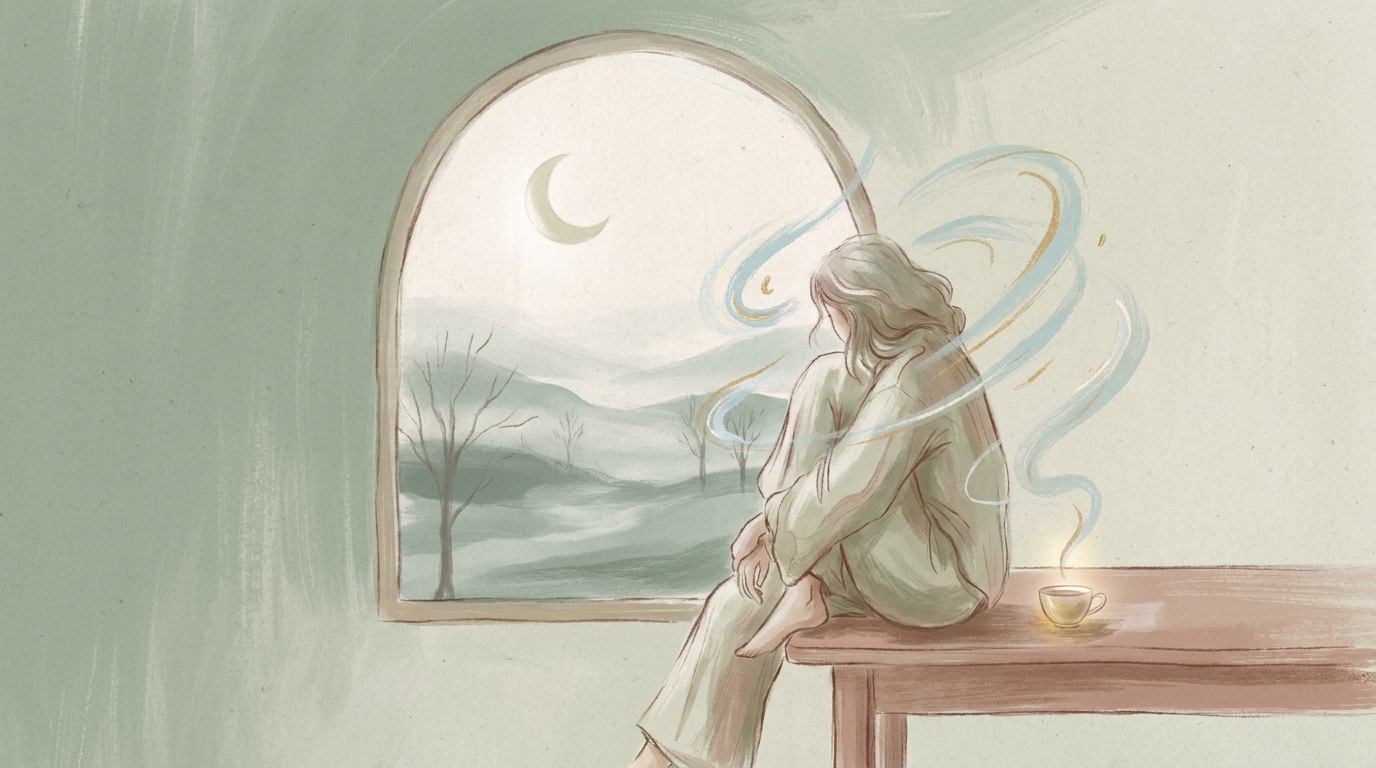
You did everything right. You are tired. The house is dark and quiet. And then you lie down, and your mind wakes all the way up.
It replays the conversation from this afternoon. It rehearses tomorrow. It reaches back three years to something that still makes you wince. You are exhausted, and you cannot stop thinking. If that is you, the first thing to know is this: you are not broken, and you are not alone. The 2 a.m. mind is one of the most common experiences there is.
Why the mind gets louder at night
During the day, your attention has somewhere to go. There are tasks, people, screens, small decisions. Your thoughts have to compete with all of it, so they stay in the background.
At night, all of that falls away. The noise stops, and for the first time in hours there is nothing for your attention to rest on. So it turns inward, and the thoughts that were waiting in line all day finally get the stage. It is not that you have more thoughts at night. It is that there is nothing else in the room with them.
There is a second reason, and it is quieter. A tired brain is a frightened brain. When you are worn down, the part of you that scans for problems becomes more sensitive, not less. Small worries feel large. A manageable concern becomes a catastrophe with your name on it. This is not a character flaw. It is a tired nervous system doing exactly what tired nervous systems do.
Why trying to stop it makes it worse
Here is the trap. You notice you are overthinking, and you tell yourself to stop. You try to force your mind to go quiet so you can finally sleep.
But force is the one thing that never works on a racing mind. Try, right now, not to think of a white bear. Notice what happens. The bear arrives, and then the effort of pushing it away, and then the noticing of the effort. Each push adds a layer. The mind is a knot that only tightens the harder you pull.
So the harder you try to force sleep, the more awake you become, because trying is itself a kind of tension, and sleep only comes to the untensed. This is why willpower fails you at 2 a.m. You are using the mind to fight the mind, and the mind always wins, because it is the only one playing.
A smaller thing that helps
If force does not work, what does? Not a bigger effort. A smaller one.
You do not have to stop the thoughts. You only have to stop squeezing them. There is a difference between a thought passing through and a thought you are gripping with both hands. You cannot always control which thoughts arrive. You can loosen your grip on the ones that do.
Try this, tonight, the next time the mind starts to spin:
Bring to mind, lightly, the worry that is circling. Do not chase the worst one; just let the nearest one come. Now notice the urge to do something with it, to solve it, to argue with it, to push it away. Feel that urge as a tightening somewhere in your body, a bracing.
This time, do not push. Take one slow breath in through your nose. As you breathe out, let your shoulders drop, and imagine loosening your grip on the thought by the smallest amount. You are not getting rid of it. You are just holding it less tightly. The thought can stay. You are simply going to stop squeezing it.
One breath. That is all. Notice that the thought is still there, and notice that something around it has gone a little softer. That softening is the whole point. It is also, quietly, the doorway to sleep, because sleep does not come when the mind is empty. It comes when the body stops bracing.
And if it comes back
It will come back. That is not failure; that is a mind. The practice is not to win once and be done. The practice is simply to return. The thought pulls you away, and you notice, and you take one more slow breath and loosen your grip again. Notice. Breathe. Return. As many times as it takes, with no scorekeeping.
There is one more small permission that helps at night. When a worry insists that it must be solved right now, you can answer it gently: not now. Morning-me will look at this. Almost nothing genuinely needs to be solved at 2 a.m., and the version of you that wakes with light in the window is far better equipped to handle it than the frightened, tired version lying in the dark.
You are not going to think your way to a quiet mind tonight. But you can breathe your way to a softer one, one breath at a time. And a softer mind, it turns out, is a mind that can finally rest.
Want a gentle place to start? One Quiet Breath: How to Calm an Overthinking Mind is a free little book — yours to keep. Twelve short chapters, twelve tiny practices you can do in a single breath, including a whole chapter for the 2 a.m. mind. Download it free here.